▶ Tap to play (60 seconds)
Quick verdict
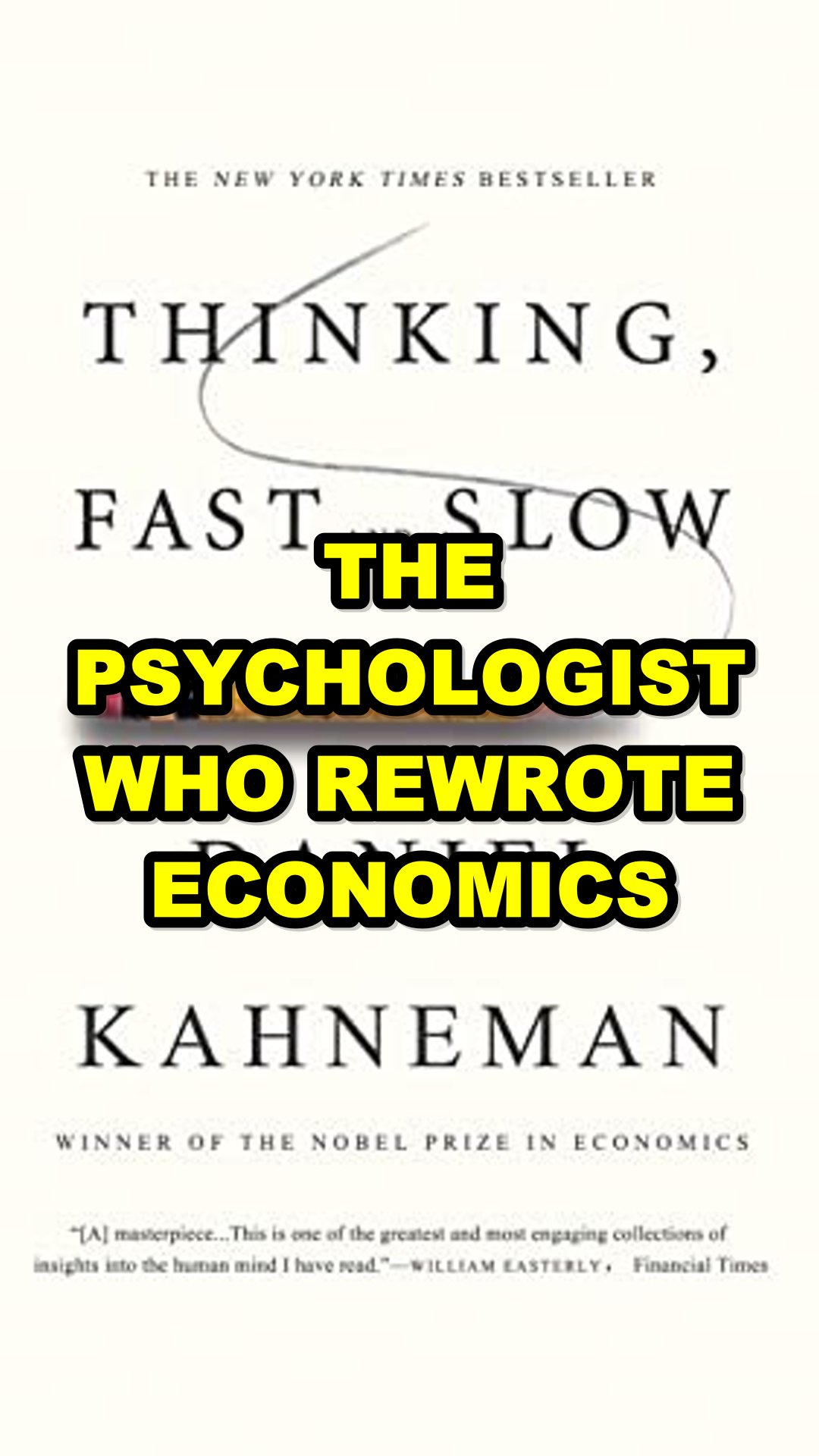
Yes — Thinking, Fast and Slow by Daniel Kahneman is worth listening to if you want a rigorous, endlessly quotable tour through the psychology of decision-making from a Nobel Prize-winning economist. It is dense in places, but Kahneman keeps returning to plain-language examples that make the science land. Nothing about the ending needs protecting here; this is a book of ideas, not plot twists, and the real payoff is how differently you’ll notice your own thinking afterward.
- Your brain runs on two systems: one fast and intuitive, one slow and effortful, and they constantly compete.
- Most of your daily judgments come from System 1, and it is far less reliable than it feels.
- Kahneman won the Nobel Prize in Economics for showing that humans are not the rational actors classic theory assumed.
What it’s about
Thinking, Fast and Slow is Daniel Kahneman’s synthesis of decades of research into how people actually think, as opposed to how economic models assume they think. He organizes the book around two “systems”: System 1, which is quick, automatic, and emotional, and System 2, which is slow, deliberate, and effortful but lazy about engaging. Through this framework, Kahneman walks listeners through the cognitive biases and mental shortcuts — anchoring, availability, loss aversion, overconfidence — that quietly steer everything from grocery decisions to major financial and medical choices. Along the way, he shares the story of his long collaboration with Amos Tversky, the experiments that built behavioral economics as a field, and the surprising limits of expert intuition, all without needing a single spoiler warning because the ideas, not a plot, are the point.
Why it works as an audiobook
Hearing Thinking, Fast and Slow narrated works especially well because Kahneman’s writing leans on conversational thought experiments you’re meant to try in real time. The audiobook format turns his “quick, what’s your gut answer” prompts into something closer to an interactive lecture, since you can’t skim ahead and peek at the answer the way you might on a page. The narration gives the material a steady, unhurried rhythm that suits dense psychological concepts, letting each idea settle before the next one arrives. It’s also a natural fit for re-listening: sections on heuristics or the “planning fallacy” hold up on a second pass once you already know where the argument is headed.
Who should read it
Thinking, Fast and Slow is best suited to listeners who enjoy nonfiction that rewards patience over pure entertainment. It’s an excellent match for anyone in business, investing, medicine, or law who wants to understand — and guard against — the biases that creep into professional judgment. Students of psychology or economics will recognize it as close to a founding text of behavioral economics, while curious general listeners will find it a genuinely useful mirror for their own decision-making. It’s a tougher fit for anyone wanting a fast, breezy listen, since the ideas are meant to be chewed on, not consumed passively.
Similar books
- Predictably Irrational by Dan Ariely — a lighter, story-driven companion piece on the hidden forces behind everyday choices.
- Nudge by Richard Thaler and Cass Sunstein — applies the same behavioral insights to policy and everyday “choice architecture.”
- The Power of Habit by Charles Duhigg — shifts the focus from snap judgments to the automatic routines that shape daily life.
FAQ
Is Thinking, Fast and Slow hard to follow as an audiobook? Some chapters cover statistics and experiment design, so it rewards a second listen, but the narration paces the ideas clearly enough for most listeners to follow on a first pass.
Do I need a psychology background to understand it? No — Daniel Kahneman writes for general readers, building every concept from everyday examples before introducing research terminology.
What are System 1 and System 2 in Thinking, Fast and Slow? They are Kahneman’s names for the brain’s fast, automatic, intuitive mode and its slower, deliberate, effortful mode, and the book explores how the two interact and conflict.
More audiobook reviews
Browse all audiobook reviews · What to watch on Prime Video · Start a 30-day Audible trial
#ad · As an Amazon Associate, Elite Books earns from qualifying purchases and sign-ups.